Why Boring Jobs Create Extraordinary Skills
The anxiety hits every time you open a news app.
AI is writing code.
AI is analyzing legal documents.
AI is automating administrative tasks.
As a parent, it’s enough to make your chest tighten. You look at your teenager, who might currently be spending their summer folding t-shirts at a clothing store, scanning groceries, or handing paper bags through a drive-thru window. It’s completely natural to feel a wave of worry:
Is this repetitive, mundane work actually preparing them for a world run by advanced algorithms? Are they wasting time?
The surprising truth?
No, they aren’t wasting time. In fact, they might be building some of the most valuable skills for an AI-driven workplace.
While the world focuses heavily on teaching kids how to prompt technology, entry-level, supposedly “boring” starter jobs are quietly forging a suite of extraordinary, high-level capabilities. These are precisely the skills that become harder to automate.
Here is why the unglamorous grind of a first job is the ultimate training ground for an AI-adjacent future.
1. From “Repetitive Tasks” to High-Stakes Chaos Management
To a teenager, working a retail or fast-food shift can feel like an endless loop of repetition. Scan the item. Bag the item. Repeat. Flip the burger. Wrap the burger. Repeat.
But look closer at what happens when the script breaks.
Imagine it’s 6:00 PM on a Friday. The restaurant’s point-of-sale system suddenly crashes. The credit card readers go dark. The line of hungry customers is wrapping around the building, and an impatient person at the front of the queue is starting to vent their frustration.
In that exact moment, your teenager is no longer just doing a “boring” job. They are participating in a practical masterclass in crisis management, real-time prioritization, and emotional regulation under fire.
The Human Skill: They have to look a frustrated human being in the eye, project calm, manually calculate a total, coordinate with a stressed co-worker, and keep the line moving.
Why AI Struggles to Replace It: Advanced tech is brilliant at processing data when the parameters are perfect. But when a physical, chaotic system breaks down and human emotions boil over, an algorithm struggles to navigate the messy reality. AI can assist with backend inventory reporting, but it cannot apply the soft-touch diplomacy required to de-escalate an impatient crowd in real time.
2. The Power of Boredom and “Operational Grit”
We live in an era designed to eliminate friction. Content is served in fifteen-second bursts. Food arrives at the click of a button. If a video or game gets boring, a teenager can swipe away instantly.
Basic entry-level jobs do something radical: they force teenagers to tolerate routine.
Learning to show up for a five-hour shift where they cannot constantly check their phone requires a psychological muscle that is becoming increasingly rare. It builds boredom stamina, focus, and operational grit.
In the future workforce, the major differentiator won’t just be who can generate the flashiest ideas. Generative AI will produce ideas by the thousands in seconds. The individuals who thrive will be those who have the discipline to execute the unglamorous, tedious, and highly detailed phases of a project without quitting when the initial excitement wears off. Your teen is learning to take pride in a job well done, even when the task itself is routine.
3. Mastering the “Human API”
In computer science, an API (Application Programming Interface) allows two entirely different software systems to talk to each other seamlessly. In the real world, the trickiest interfaces belong to human beings.
When your teenager works a starter job, they are thrown into an environment where they cannot choose their network. They are forced to interact with:
The Difficult Manager: A supervisor who might be stressed, disorganized, or bad at communicating.
The Diverse Team: Co-workers from completely different generations, backgrounds, beliefs, and life experiences.
The Unpredictable Public: People who are tired, distracted, or having a difficult day.
By navigating this daily melting pot, teens develop deep empathy, professional boundary-setting, and social intelligence.
AI can generate language and synthesize human speech perfectly, but teenagers still need to develop the judgment and empathy required to use communication effectively. They need to learn the exact tone of voice required to tell a manager they need to change a shift, and the precise body language needed to make an elderly customer feel respected. These nuance-heavy, relationally driven human interactions are incredibly difficult to replicate digitally.
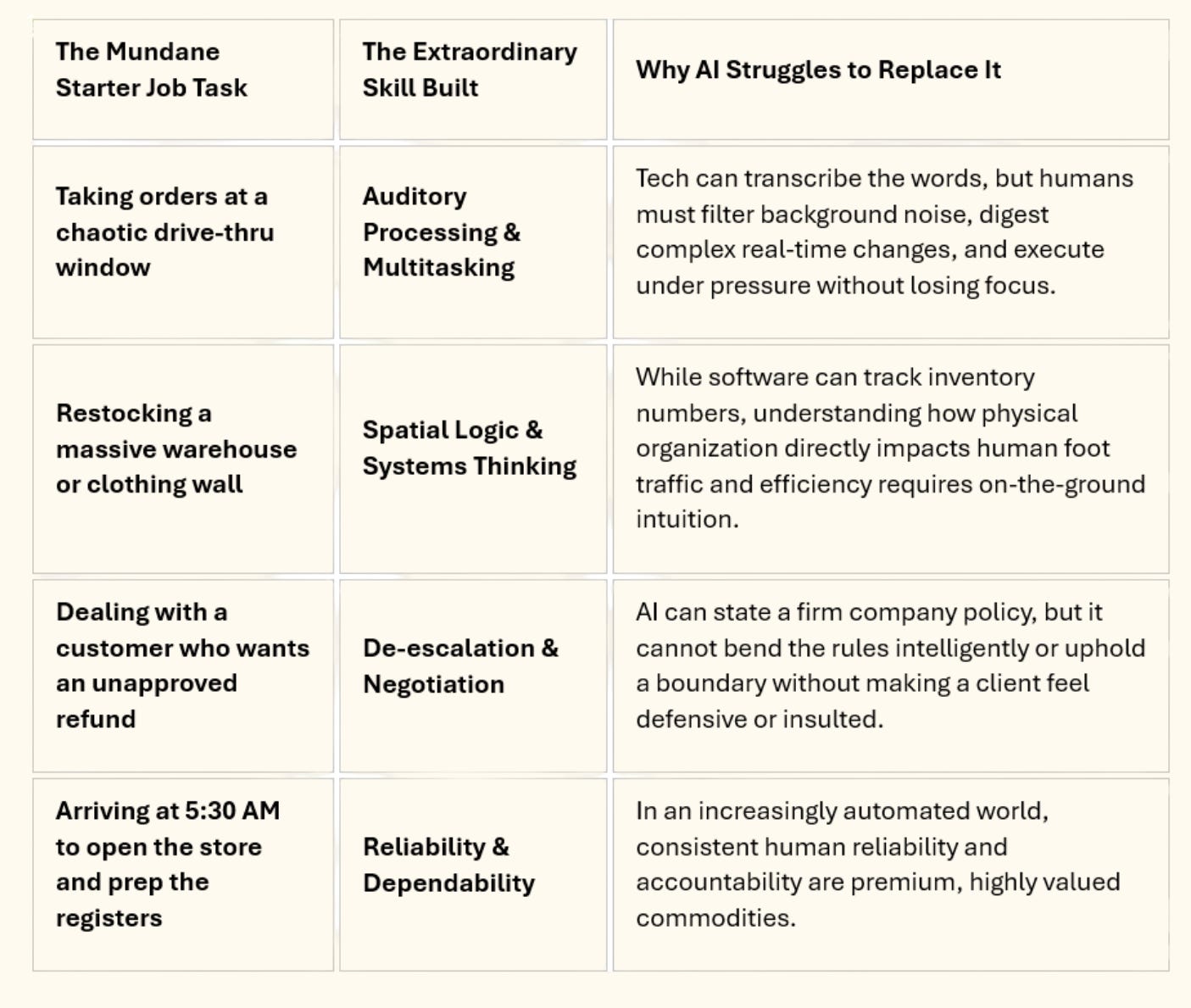
Mapping the Metamorphosis: How Tasks Become Strengths
To help ease your anxiety, let’s look at how the basic chores your teen handles actually translate into massive corporate and entrepreneurial advantages.
How to Reframe the Conversation
The next time your teenager slumps onto the couch after a long shift and groans about how much they hate their job, resist the urge to just say, “Well, it builds character.” Instead, help them connect the dots between their daily grind and their future value.
Try shifting the post-work conversation with these three practical questions:
“Who was the most difficult person you had to deal with today, and how did you handle them?” (This highlights their emotional intelligence and communication skills.)
“If you owned that store, what is one thing you would change to make the employees’ jobs easier or the customers happier?” (This activates their executive function and operational thinking.)
“What was the most chaotic moment of the shift, and what did you do to get through it?” (This reinforces their resilience and stress tolerance.)
The Takeaway
Take a deep breath. The tech landscape is going to continue evolving at a dizzying pace, and the technical tools required for tomorrow’s jobs will change constantly.
But the foundational human traits—grit, empathy, reliability, and the ability to handle physical chaos—remain deeply critical. By letting your teenager work a “boring” job, you aren’t holding them back from the future. You are giving them the exact real-world anchor they need to thrive alongside it.