What Employers Really Want When They Ask Teens for Experience

It is the classic catch-22 that has frustrated young job seekers for generations: “You need experience to get a job, but you need a job to get experience.”
For today’s teens, this hurdle feels even higher. As artificial intelligence advances at breakneck speed, parents are left wondering how to help their children prepare for a shifting workplace. If an AI can draft an email, write code, or analyze data in seconds, what kind of “experience” are entry-level employers actually looking for?
When employers ask for experience, they are rarely looking for years of technical expertise. They are looking for evidence. Evidence that a teenager can be trusted, learn quickly, work with others, and keep going when things get difficult.
Experience has never been just about technical ability; employers use it as a shortcut. Because they can’t observe every candidate over a six-month trial period, they look at a resume for proof that someone has already demonstrated reliability, initiative, and human judgment.
Employers aren’t simply looking for someone who can follow instructions. They’re looking for the judgment, accountability, and interpersonal skills that become even more valuable as technology handles more routine work.
This shift changes the questions we need to ask as parents. Instead of wondering, “How do I get my teen an impressive internship?” we should be asking, “What experiences would give an employer evidence that my teen is dependable, adaptable, resourceful, and eager to learn?”
To help your teen stand out, you can guide them to build what we call The Resilience Portfolio: four distinct pieces of evidence that entry-level employers value above all else.
1. Evidence of Reliability: “Can You Manage Yourself?”
When an employer looks at a teen’s resume, their biggest fear isn’t that the teen doesn’t know how to run a specific software; it’s that they won’t show up on time, take feedback, or put their phone away.
Basic human reliability is a premium currency. These are the capabilities employers still rely on people to demonstrate. They want to see that your teen has functioned in an environment where someone other than a parent or teacher was counting on them.
What it looks like: Showing up for early morning lifeguard shifts, managing a neighborhood lawn-care route, or consistently refereeing youth soccer games.
How parents can help: Stop waking your teen up for commitments. Let them handle the consequences of a missed alarm or a forgotten uniform now, while the stakes are relatively low.
2. Evidence of Adaptability: “How Do You Handle Friction?”
While AI can handle increasingly complex data, humans are still the anchors when environments become emotionally charged or unpredictable. Employers want to know: What happens when a customer is frustrated? What do you do when the team’s plan falls apart at the last minute?
Experience means your teen has faced minor workplace adversity and navigated it constructively.
What it looks like: Working the cash register during a Friday night rush at a fast-food chain, handling returns at a retail store, or counseling homesick kids at a summer camp.
How parents can help: When your teen comes home complaining about a difficult boss or an annoying coworker, resist the urge to step in and fix it. Instead, play coach. Ask: “That sounds incredibly frustrating. How do you think you’ll handle seeing them tomorrow?”
3. Evidence of Agency: “Can You Figure Things Out?”
Because AI can retrieve factual information almost instantly, simply knowing facts is less of a competitive advantage than it once was. Increasingly, employers value people who can ask good questions, evaluate information, and apply it effectively. They want evidence of agency-proof that your teen won’t sit idly waiting to be told exactly what to do for eight hours.
What it looks like: Organizing a school charity drive from scratch, troubleshooting the audio equipment for the school play, or teaching themselves how to edit videos for a local small business’s social media.
How parents can help: Encourage your teen to use AI as a thinking partner—not as a substitute for thinking. Encourage them to use it to brainstorm solutions or learn a new concept, but emphasize that learning how to ask better questions, verify information, and improve AI-generated work is a crucial skill.
4. Evidence of Continuous Growth: “Can You Learn New Things?”
The ability to continuously learn may be the defining career skill of the AI era. Because technology updates faster than school curricula, employers need to know that a candidate can learn new tools and adapt without constant direction.
What it looks like: Teaching themselves Excel for a personal project, picking up a new sport or instrument, experimenting with new AI tools to automate a tedious task, or actively applying feedback to improve their performance.
How parents can help: Shift from giving answers to asking, “Where do you think you could look to find that out?” Praise the process of learning and experimenting rather than just the final grade or achievement.
The Non-Traditional Resume: Framing “Hidden” Experience
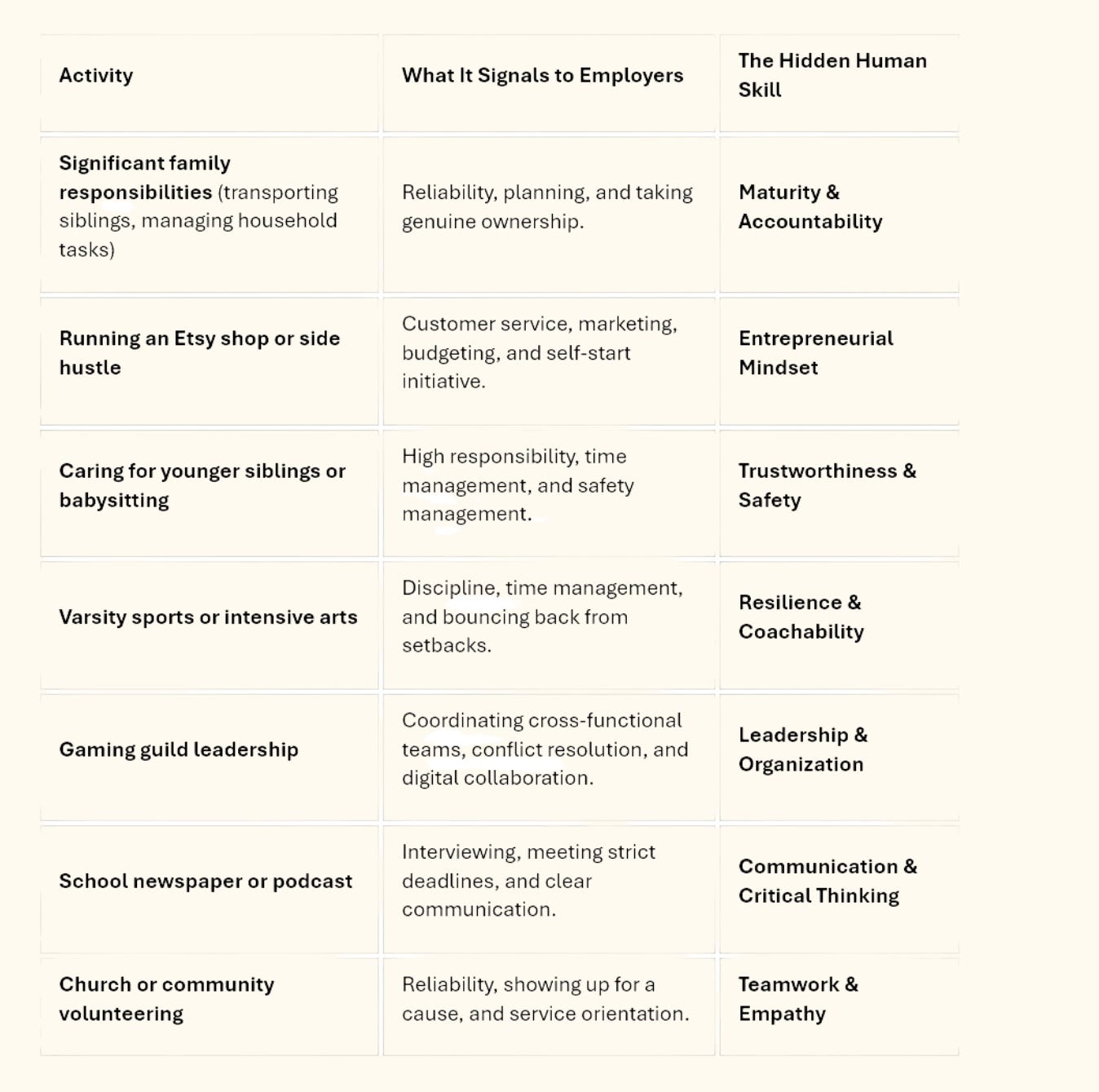
If your teen doesn’t have a traditional after-school job, they aren’t out of luck. Parents often underestimate everyday activities because “it’s just life,” but employers see them as vital pieces of The Resilience Portfolio. You can help your teen translate these activities into the language of professional readiness.
The Big Picture for Parents
Don’t panic about your teen mastering a specific, hyper-technical skill before they graduate. The landscape will change by the time they enter the workforce anyway. Focus instead on helping them collect evidence for their Resilience Portfolio: habits that employers can’t assume from a transcript alone. Reliability, sound judgment, resilience, curiosity, and the ability to keep learning won’t guarantee career success, but they will help your teen adapt as jobs, industries, and technologies continue to evolve.